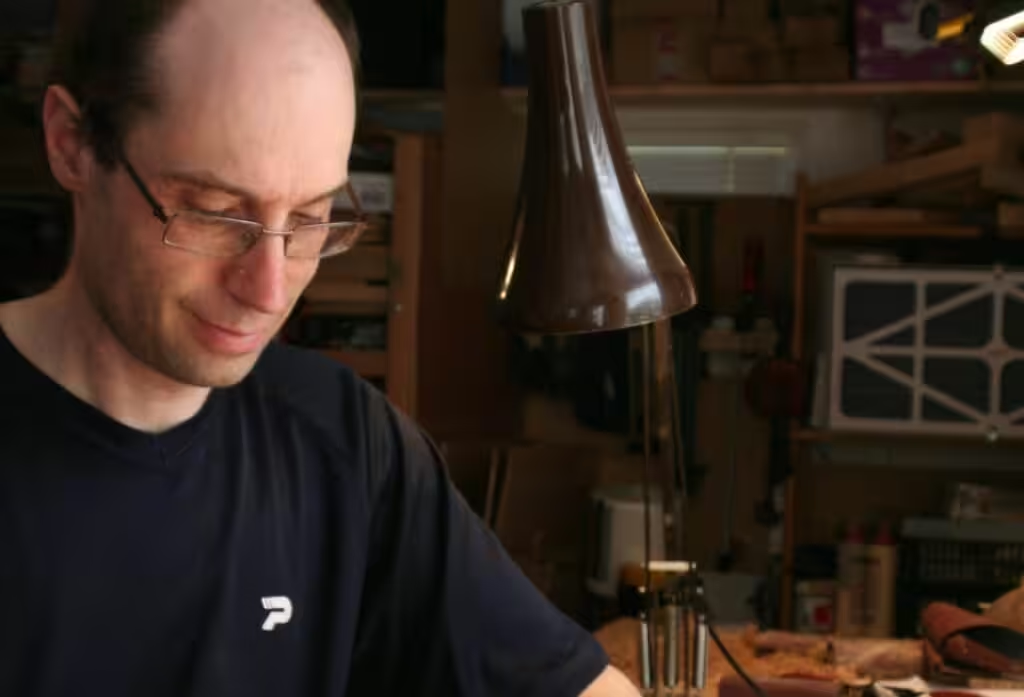
David
If you saw me walking down the street, you’d think I look relatively “normal”. And that is because I am “normal”. But what you wouldn’t see are multiple “invisible disabilities” which I’ve grown used to over 30+ years, but which are still nevertheless devastating.
Primarily I have Postural Tachycardia Syndrome (PoTS), apparently causing my most challenging conditions of Gastroparesis, muscular pain & Anemia/Neutropenia. I also have MCAS, Breathing Pattern Disorder & Chronic Rhinosinusitis. Through a lot of hard work from myself, I’ve received excellent medical assistance.
I have chosen to get on with life however, calmly accepting what I have, keeping things in perspective & adapting to achieve a quality of life. I see this as a journey and so look at what I can do, not what I can’t. I look for positive things I can do each day, striving for a quality of life by looking after myself. This means having the confidence to learn by trial and error what works best for me (a diary helps), by not giving up, pacing myself, and trying to forgive myself when things don’t work out. So my “normal” is different to others “normal”.
I’m a 48 year old father, married with two children (8 & 10). Parenting can be challenging (especially with health conditions & young children), however I put a lot into it and spend much time with them – it’s the best choice I ever made.
PoTS affects people differently – to some, it is about people fainting/headaches etc. Whilst I have challenging widely varying & high heart rates, these are not my most significant symptoms.
Impact.
Despite the significant impact on my life, I can’t resign, retire, have a holiday or escape from the conditions. They are always present always 24/7 whether I like it or not. But I’ve also got used to them, so it doesn’t frighten me.
Whist most people have been reasonable, over the years I’ve experienced my fair share of prejudices/disbelief/negativity, and at times been made to feel wholly ashamed of the body I have. The 20th Century is littered with groups of people with apparent ‘differences’, whom society now accepts (or is learning to accept). In our inclusive society, I wish to be accepted too, despite my “invisible disabilities”, rather than questioned/asked “whether I need special help”/viewed as someone “with problems”, as I am far more than my disabilities, and disabled people have so much to give, using their differences to give a different perspective.
Like many, my diagnosis was long and complicated. Eventually an incorrect diagnosis with a rare pituitary gland condition called Diabetes Insipidus was given, resulting in low salt levels taking Desmopressin, and Ambulances, A&E, hospital stays etc. With a correct PoTS diagnosis (through Dr Gall & standard tests), it isn’t surprising that 12 daily salt tablets helped the most – however there is no ‘cure’, so they don’t ‘fix’ it. First symptoms appeared in the late 1980s whilst a teenager, getting a proper diagnosis aged 42 in 2016 was a long time of not being listened to or believed.
Getting a proper diagnoses was a huge relief to me, not a set back.
Getting a proper diagnoses was a huge relief to me, not a set back. Whilst there isn’t a magical solution, there are things I can do. Whilst these aren’t always easy, I look at the positives, not giving up, working with changing conditions.
Each day, I take 14 different medications/vitamins, at 8 different times. They help to a degree, but do not “make me better”. To be effective, I need regular breaks during the day too.
Gastroparesis is my worst condition. My stomach doesn’t empty “in the usual way”, resulting in 7 small meals a day of very restricted softer foods. Eating is aimed at nutrition and maintaining my weight, eating healthy things first each meal time. Taste is irrelevant, condition also varies over time. To some this would be a frightening challenge. After 30 years, to me this is normal.
Eating.
Eating similar sized meals at 7:30, 10, 12:30, 3, 5, 7 & 9 pm requires discipline and is a part-time job. Measuring out precise quantities/weights helps considerably – may sound OCD but it is vital – slightly too much overfills my stomach and causes many problems. Too little, and I don’t get nutrition and lose weight. It is a very fine balance.
Dietary changes have helped my PoTS symptoms – I drink no alcohol either.
Anaemia/Neutropenia mean a lot of infections (colds and especially sinusitis), and stomach bugs. Neutropenia means very careful food preparation & storage. Time off due to infections is necessary at times.
Muscular pain is mainly in the back, shoulders, wrists and hands. ‘Work’ chairs are painful, even with the best ergonomic chair/desk. I built my own desk to my own specification – doesn’t solve the problem, but it helps. Getting up and moving every 15mins isn’t ideal with PoTS. Currently trying exercises every 10min whilst sitting down, and floor stretches every hour. After 30+ years I still learn & adapt.
Using electronics.
Touch screen devices are hard. I can use my smartphone for a short time, but after that fingers, hands and wrist get painful/freeze. I don’t sit tap tap tapping every day – I can’t. Computer mice & keyboards are adapted too – standard mice are impossible for me to use.
Other PoTS symptoms such as temperature control, palpitations, noise/light sensitivity & brain fog are present too, which I find ways to deal with – pacing is key.
Time management is central to my life, using time available to get most done, for work and home tasks. Project management software helps, and after an infection, everything is written down ready to start again (reducing stress). Daniel Pink’s book ‘When?’ helps planning which are my most productive times of day – so I get more done.
Work.
Work is a challenge. Full-time employment isn’t possible, nor has it been for years – too many infections and other issues. I work freelance with online research, but not directly with people. I miss being challenged, being led and leading, teamwork, making a difference in the world, being appreciated and having the identity of “someone” who does “something”, even though I do something. Wanting to be successful at something can be a dilemma with conditions like this.
Having attended a private school, worked hard for a university degree in computer programming (with an industrial year in Oxford), and the like, this is especially hard. There are so many projects I could have been part of over the past X years. Hard seeing others getting new jobs/careers/opportunities, knowing that I will never get those myself.
In conclusion, it is hard to relate 30+ years experiences into one story. However, if you are on this journey, whether it is starting or a long way on it, I wish you well and hope you too will find some quality of life along the way. Writing down about my experiences / keeping a diary helps me considerably. Even if your life is very limited, sharing your story – or even just writing it down / dictating it to someone – may be one way to help you in the long term.